When a new Shopify project starts, one of the first decisions I make with the client is whether the store should be a classic Liquid theme or a headless Hydrogen storefront. It affects performance, cost, the speed of development and how much the client will spend on maintenance for years. It is a business decision first and a technical one second.
The real example in this post is the Shopify Hydrogen B2B store for an ophthalmology devices company. If you are weighing the same decision for your store, my Shopify development page explains how I work on both.
Hydrogen is newer, and it is easy to treat newer as better. I do not. For many stores, a well-built Liquid theme is the better and cheaper choice. Here is how I decide.
What each option really is
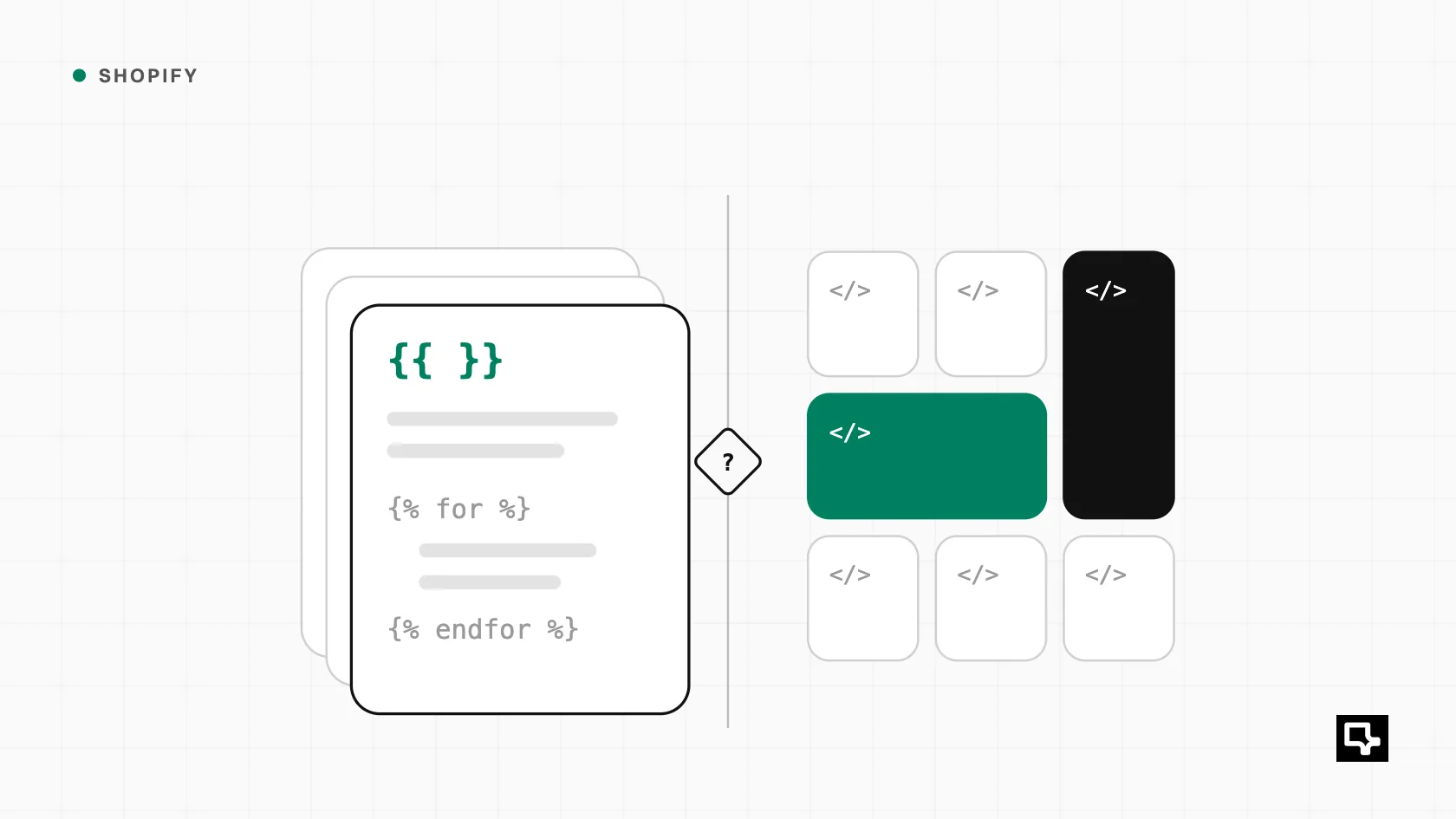
Liquid is Shopify's native templating language. A Liquid theme runs on Shopify's own infrastructure, renders on the server, works directly with the theme editor, and is compatible with almost every app in the Shopify App Store. There is nothing to host and very little to operate.
Hydrogen is Shopify's React-based framework for headless commerce, built on Remix. Shopify stays the commerce back end (products, inventory, checkout), while the storefront is a custom React application. You get full control over the frontend, and with it, full responsibility for hosting, caching and performance.
The questions I ask
1. How complex are the catalog and the buyers?
A store selling a few hundred products to consumers fits Shopify's standard patterns well. A catalog of technical products, sold to professional buyers with their own pricing, ordering habits and information needs, often does not. The more the catalog and the buyers differ from standard retail, the more Hydrogen starts to make sense.
2. Does the buying flow need to be custom?
Liquid themes are flexible, but they live inside Shopify's page structure and buying flow. If the store needs a flow that Shopify does not support well, such as a professional ordering process or product pages that work very differently from a standard product template, a theme will fight you. Hydrogen gives you full control over that flow.
3. What can the team maintain?
This is the question that is easiest to skip and most expensive to get wrong. A Liquid theme can be maintained by a much wider range of developers, and much of the day-to-day work can be done in the theme editor. A Hydrogen storefront is a React application: whoever maintains it needs solid React and frontend engineering skills. If the client's team cannot support that, Hydrogen becomes a long-term dependency on whoever built it.
4. What will hosting and maintenance cost?
With Liquid, Shopify hosts the storefront. With Hydrogen, you host and operate the application, monitor performance, handle caching, and keep dependencies up to date. These are real, ongoing costs, and they should be part of the decision, not a surprise after launch.
5. How much does the store depend on apps?
Many Shopify apps work by injecting code into a Liquid theme. In a headless storefront, many of them do not work out of the box, and each one has to be integrated through APIs or replaced with custom code. A store that relies on a long list of apps pays for that in a Hydrogen build.
A real decision: the ophthalmology B2B store
On the ophthalmology B2B store, the buyers are professionals ordering specialised devices, and the products need much more explanation than a typical store can show. The client also wanted a renewed, clearly medical look and a buying path built around how professional buyers actually order. A theme could have handled the catalogue, but every custom part of the B2B flow and the product presentation would have been a workaround inside theme limits. Hydrogen gave us full control over the frontend, better performance, and a foundation the client can keep extending. For a standard consumer store with the same catalogue size, I would still have recommended Liquid.
When Liquid is the better choice
For most stores, I recommend Liquid when:
- the store follows standard e-commerce patterns,
- time to market matters most,
- the client wants Shopify to handle hosting,
- the team that will own the store does not work with React every day,
- the store depends on several apps that integrate through the theme,
- or the budget needs to go into marketing and conversion work rather than infrastructure.
A well-built custom Liquid theme can be fast, accessible and distinctive. Many of the performance problems people blame on Liquid come from heavy apps and unoptimized themes, not from Liquid itself. Fixing those is usually much cheaper than moving to a headless architecture.
How I decide
The difference between Liquid and Hydrogen is not about which one is more modern. It is about fit. Liquid prioritizes stability and operational simplicity. Hydrogen prioritizes flexibility and control.
My recommendation always starts with the business: how the client sells, who buys, what the team can maintain, and what the store will cost to run. Putting an early-stage business on a headless architecture often increases cost without adding value. Putting a complex B2B operation on a theme that fights its buying flow costs money in a different way.
If you are unsure which one fits your store, that is exactly the kind of question I like to work through on a short call, before anyone writes code.